
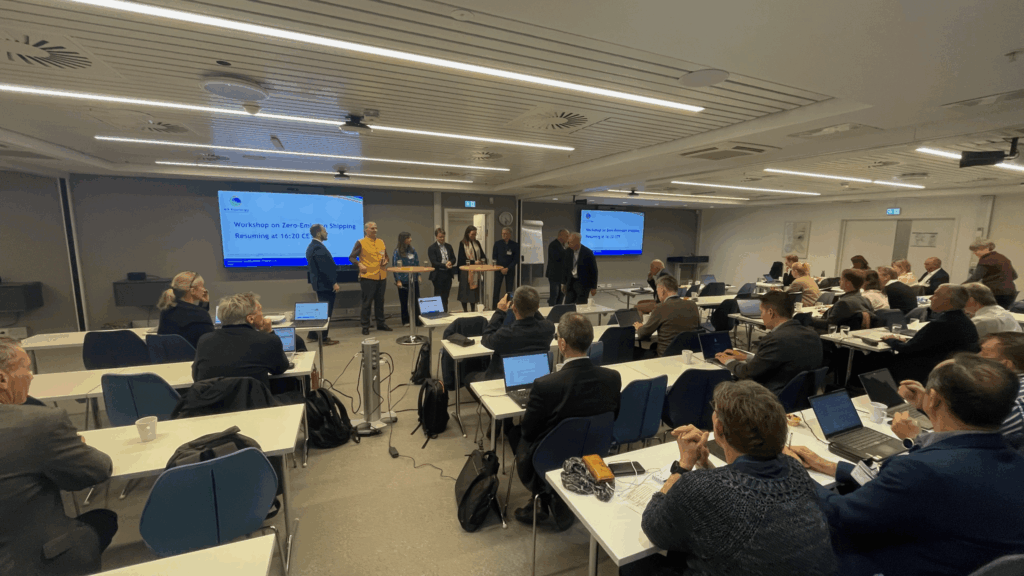
On 19 November, IEA Bioenergy Technology Collaboration Programme hosted — in Oslo and online — a full-day session focused on how the maritime sector can transition to zero-emission shipping.
The maritime sector generates roughly 3% of global greenhouse gas emissions, an impact comparable to global aviation. Historically, however, efforts to develop regulations and priorities for climate change mitigation in shipping trailed those in the aviation industry. Aviation has been actively working on sustainable aviation fuels and establishing mature regulations for over ten years.
This gap is rapidly closing. The European Union has taken the lead, implementing two regulations since 2021 that establish clear, aggressive pathways for reducing carbon intensity in both sectors towards 2050.
Globally, the IMO significantly advanced its agenda in April 2025 by finalizing the “IMO Net-Zero Framework”—draft legislation setting direction for climate action in international shipping.
FUEL-UP project coordinator, Duncan Akporiaye, participated in the workshop with a presentation focused on the developments in liquefaction and co-processing pathways, with insights from projects like 4REFINERY, FUEL-UP and REFOLUTION
Thanks to IEA Bioenergy Technology Collaboration Programme for organising such an important and strategic event at a time of significant change for the maritime sector.
Learn more:
https://www.ieabioenergy.com/blog/publications/ws32-iea-bioenergy-tcp-workshop-zero-emission-shipping/
FUEL-UP Presented at AIChE 2025
Green methods like HTL, pyrolysis, and fermentation turn waste into clean fuels. But for the entire process to be economically sustainable, we must efficiently recover